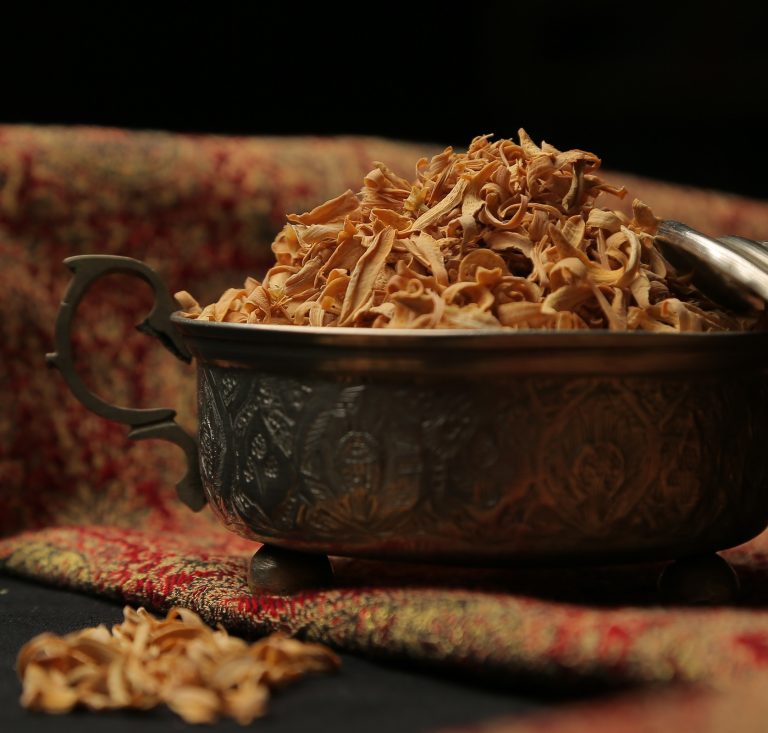
Orange Flower

Orange Tree is an evergreen plant, a tree up to 5 meters high. The fragrant flower of the orange tree (Citrus sinensis) is well-known as Orange Flower or Orange Blossom. While fresh, orange flower has a pleasant aroma and taste. The orange flower’s petals are white and it has five sepals, five fleshy petals, and twenty flags.


Its fragrance is used in perfume making, is famous as an aphrodisiac, and abundant in two states of Iran, Mazandaran in the north and Shiraz in the south. The essence of Orange blossom is a significant component in perfume manufacturing or is used as an ingredient in ground form or orange flower water in culinary preparations. The Orange Flower’s petals can also be made into the fantastic aromatic orange flower water which is common in Middle Eastern cuisine and some European countries’ cuisine. As a result, it is considerably used as an ingredient in confectionary for making a long list of desserts and sweets.


In mid-May, orange flowers bloom. Orange flowers are usually harvested early in the morning. The harvest of the orange flowers is mainly carried out in a traditional way. In fact, a large piece of cloth is spread under each tree in order to collect the petals as clean as possible. Afterward, fallen blossoms are taken to the factory in order to be double-sorted and finally wrapped into special packages. Orange flowers are usually dried in the dark and then used to make orange flower tea, essential oil, water, or jam. Moreover, Orange flower water is the result of the distillation of scented by-product of fresh bitter-orange blossoms for their essential oil.


Orange blossom is a plant that has a lot of useful benefits for our health and is full of different vitamins such as vitamins C and D. This plant is rich in magnesium, manganese, boron, calcium, zinc, selenium, sodium, copper, potassium, and vitamins B, C, and D, as well as active compounds including flavonoids and furanocoumarins. It also strengthens the nervous system of the body (having a relaxing effect) and the stomach, regulates heart rate, and prevents seizures and heart attacks. Additionally, it also quickly reduces nervous headaches and migraines. So, try to enjoy your evenings with a cup of orange flower tea.


Iran is a country of four seasons

Iran is a country of four seasons. Due to the special geographical location of Iran, its location between the two seas, its special topography and many other factors, special and unique plant species can be found everywhere in Iran. Plant diversity of Iran is so vast that it makes it unique among other countries in the Middle East.

Iran is very rich in vegetation due to its great climatic diversity and unique topography. In fact, every part of the country has its own plant. Desert areas have saline plants and foothills have wild foothill plants. In fact, changing climatic conditions have led to the creation of different ecosystems in Iran. This climatic diversity has created significant biodiversity in Iran, about 8,000 species or units of plant subspecies have been identified in this country, of which about 2500 are native units. This number of plant species is equal with plant species throughout Europe continent.  
In a series of blog posts, we will introduce you with some famous species of native plants of Iran. So, stay tuned to Alborz Herbs.

Medicinal Usages of Plants

Introduction
Since man is a part of nature, certainly nature has provided a cure for every disease. The closer is man to nature, the healthier he is and the longer he lives. For this reason, the more man turns to nature and benefits more from its blessings, the better and more confidently his disease is treated. It should be considered that chemical drugs are not the ultimate answer for humans. Natural factors play an important role in treatment and medicine, even in manufacturing chemical medicines which consequently results in preventing diseases. The presence of medicinal plants in nature is one of its great blessings.
History of human use of medicinal plants
The history of treating diseases with medicinal plants dates back to the history of human living on Earth. According to the experience, humans and animals treat themselves with the help of medicinal plants according to their needs. They are found in plains, vast pastures, forests, foothills, etc. They have been in this way of life for thousands of years, beautifying nature.
The relationship between medicinal plants and disease
The diversity of medicinal plants is related to different soil and climate and each plant grow in its special context. Moreover, not all medicinal grow in a specific season. Yet, not much research has been carried out on the relationship between the prevalence of the disease in a season or a time and the abundance of medicinal plants in that season, but we know that many diseases occur in a particular season, and some medicinal plants abundantly found in the same season.
Important compounds of medicinal plants
Every substance found in a plant has a special benefit. The substance can be found in the structure of the plant performing vital functions or it can play a role in the structure of the physical and chemical properties of the plant.
   Aromatic oils: Aromatic substances are cleansing, disinfectant, appetite stimulant, digestive, analgesic, anti-flatulence, and anti-muscle spasm.
   Alkaloids: Alkaloids include a variety of drugs, including morphine, codeine, and cocaine. Each of these substances has a specific role in the treatment of diseases.
   Protein: Protein is made up of a combination of amino acids. Humans are unable to synthesize half of the amino acids and must enter the body through eating plants and animal meat.
   Bitter taste: Many herbs have a bitter taste, such as chicory, which has medicinal and therapeutic properties. Bitter non-toxic substances stimulate the appetite and activate many body organs for more such as the liver and gallbladder.
   Flavonoids: Flavonoids are active substances that are mainly found in organic plants. These substances neutralize a variety of toxins in the body.
   Tannins: have analgesic properties, tighten and clean the gums and skin of the mouth. They have a positive effect on the stomach and intestinal wall.
   Other ingredients in herbs include vitamins, phytic acids, and sugars.
Preparation and conversion of medicinal plants
Every plant in nature has its growth process. Properties of plants change in different seasons, or day and night, for example, some plants become fragrant in the morning and some in the evening and night. Therefore, in terms of medicinal properties, the appropriate time of harvest is of particular importance. Different parts of the plant also have different medicinal effects.
In many cases, the active ingredient is mainly in the leaves, flowers, stems, roots, seeds, or fruits. Flowers are always picked before noon when the dew or night moisture is gone. Some plants should be stored in closed containers or linen bags. Those who store should visit the samples regularly and be aware of possible pests and diseases.
Preparation of herbal powder
It is not possible to prepare most plants fresh during the year. Therefore, the collected plants should be crushed, grounded, or powdered after drying and kept in wide-mouth jars. The powder can contain plant organs that are stored separately.

Add a new location

Edit Location

Add up to 5 images to create a gallery for this location.

×